
Associate Professor of Chemistry
Where did you obtain your degrees?
- BS in Molecular Genetics from The Ohio State University
- PhD in Chemistry from Purdue University
What did you get your degree in, and what inspired that choice?
At the time, I was particularly interested in cancer research since several close family members had passed from the disease.
I chose molecular genetics for my first degree because I believed that since most diseases arise from genetic mutations, research should be done to determine whether we could “repair” gene mutations.
As I started researching graduate programs, I also became interested in Alzheimer’s disease and other brain-based diseases such as schizophrenia and bipolar disorder. These illnesses have been notoriously difficult to diagnose and treat, and I wanted to contribute to progress in these fields. I decided to attend Purdue University because their PULSe program let me rotate through multiple labs in different areas of the sciences so I could learn which research interested me most. I wound up earning my PhD in Chemistry with a Membrane Biology focus. It was the best decision for me!
Here are a few publications:
The SLAM Program: Fostering Curiosity in Chemistry in a Rural North Carolina Middle School (The SLAM Program: Fostering Curiosity in Chemistry in a Rural North Carolina Middle School). This publication discusses an after-school STEM program that I established while a Professor at Warren Wilson College in Asheville, NC.
Reversible dimers of the atypical antipsychotic quetiapine inhibit p-glycoprotein-mediated efflux in vitro with increased binding affinity and in situ at the blood-brain barrier (https://pubmed.ncbi.nlm.nih.gov/24483607/). This paper is the culmination of my PhD research.
Tell us about your first job after you graduated from college.
After I finished my PhD, I joined the Cleveland Clinic’s Lerner Research Institute as a postdoctoral researcher. While there, I studied the calcium transporter TRPC6 and its role in arterial healing after injury. My project was both biology and chemistry focused, allowing me to perform cell-based and chemical synthesis research. By this time I knew that I wanted to pursue a career in education, so I also worked as an adjunct professor, teaching chemistry at a nearby community college.
How did your career path lead you to teaching at Tiffin University?
I have finally found my ideal teaching environment with Tiffin University. Our class sizes and teaching expectations are perfect, in my opinion. I am able to get to know my students and work with any who seek help.
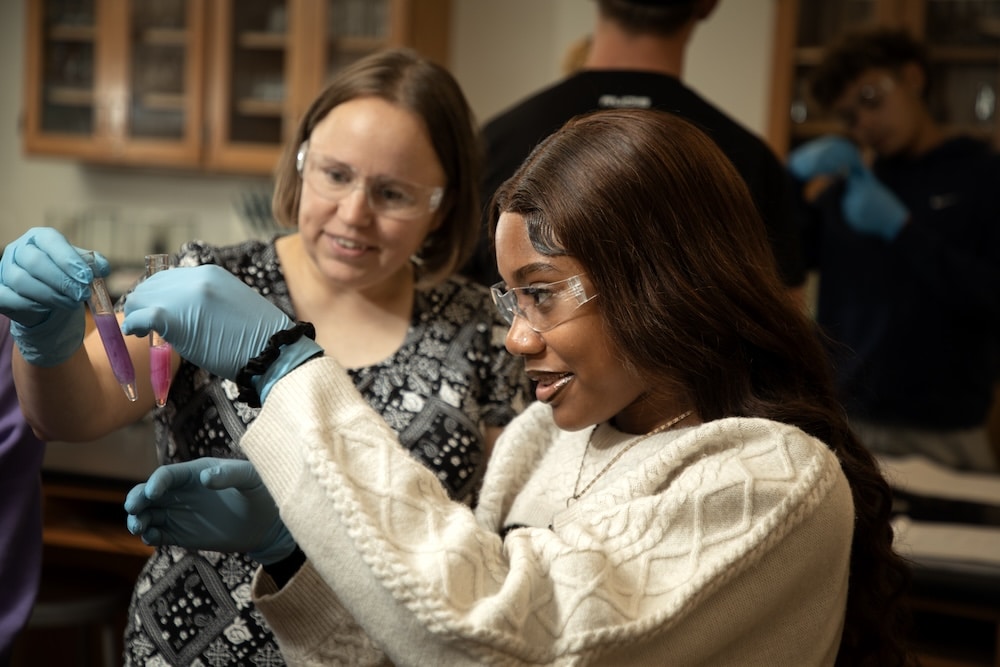
Chemistry is a difficult subject, and I love it when I can work with students and see their “aha” moments of understanding. I live for this! In addition to this, I have amazing colleagues. We work well together, and I really do form strong bonds with them and our students.
Being a scientist, I am a big fan of saying things like, “What do you think? Let’s try it out!” Some of our best learning comes from the mistakes we make.
How do you prepare students for challenges they’ll face in their careers/after graduation?
Students will be challenged to use their “soft skills” after graduation. It may not seem like it at first, but our chemistry courses help students develop skills such as organization, problem-solving, critical thinking, adaptability, time management, communication, and team-work.
We challenge our students to apply critical thinking and problem-solving skills on a daily basis. We have multiple assignments due each week, which encourages students to stay organized and to manage their time effectively. In addition, our labs foster adaptability, communication, and team-work. I hope that students appreciate the development of these skills while also learning chemistry.
What makes Tiffin University stand out to you as a faculty member?
Our class sizes and teaching expectations are perfect, in my opinion. I get to know all of my students and have the time to work with any who seek help.
In addition to this, I have amazing colleagues. We work well together, and I really do form strong bonds with them and our students. Dr. Sabo and the CSTEM patio go a long way to making us all feel welcome!
How do you incorporate TU’s motto – “Without risk, there is no gain” – into your own life or classroom?
Being a scientist, I am a big fan of saying things like, “What do you think? Let’s try it out!” Some of our best learning comes from the mistakes we make. In my classroom, I ask all students to participate in class, whether they think they are right or wrong when they provide an answer. We can learn just as much, if not more from an incorrect answer! I follow this motto in my life too. I have picked up and moved to new states and schools in search of my ideal job. I have finally found it. Without having taken those risks, I would not have wound up here!
What’s a fun fact most people don’t know about you – or an interesting hobby?
I absolutely love to garden! More unique to this is my love of growing a variety of fruits. I currently have blackberries, black and red raspberries, figs, currants, and goosberries. Who knows what other fruits I will find to plant this year?
What’s your favorite book, film, or quote – and why does it resonate with you?
I can’t say that I have a favorite book, film, or quote. I am a big fan of mystery novels. I love to try to figure out “whodunit” before it is revealed in the plot. I love puzzles, so these really resonate with me.