
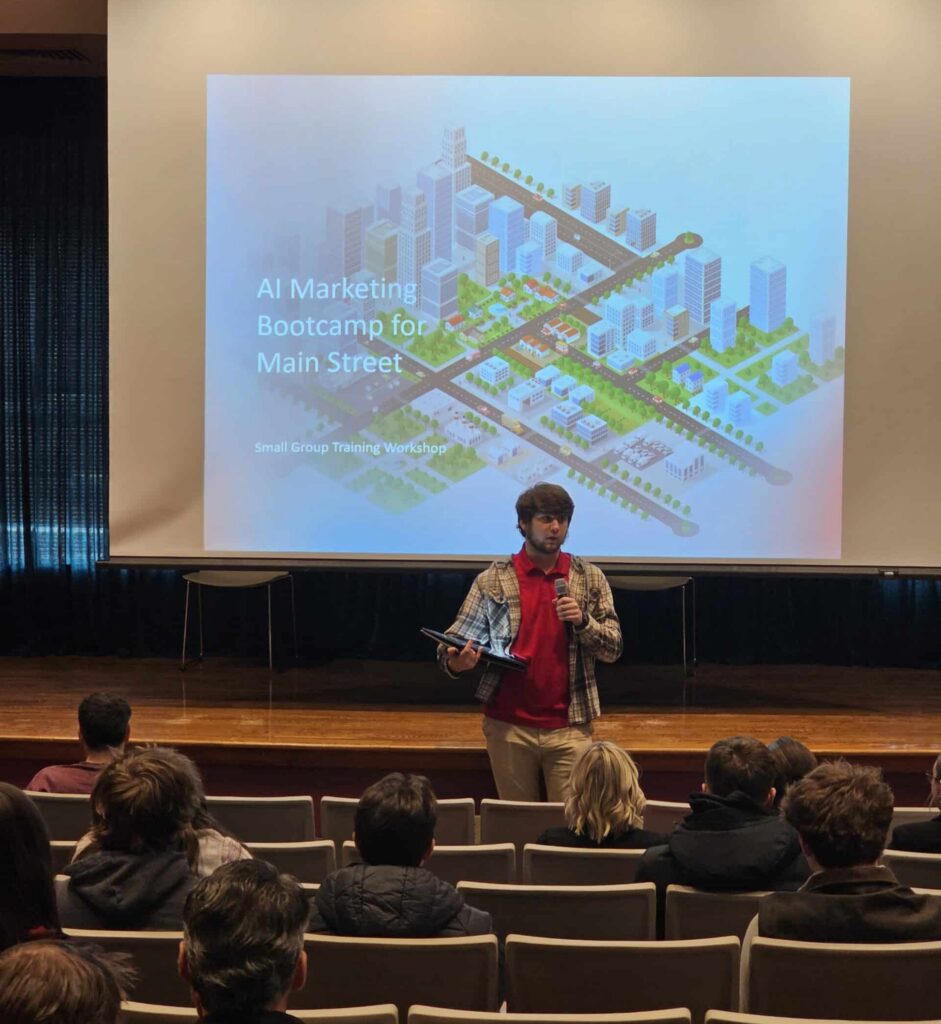
Across Seneca County, many small businesses are seeking practical ways to use AI to support their day-to-day operations. They want to improve marketing, streamline tasks and better understand their customers, but they also need clear guidance on where to start and how to use these tools responsibly. To help meet that need, Tiffin University partnered with the Seneca County Collaborative to host a Small Business AI Lunch & Learn that put TU students in the role of trainers and guides.
The session brought local business owners together with TU Computer Science majors in CST 460 (Capstone Project). Among them were Grant Glaser and Douglas Sherck, who were specifically trained to serve as AI trainers for this initiative. Under the leadership of Dr. Blasi and in collaboration with Dr. Kellie McGilvray, the event introduced AI in accessible terms and focused on practical, real-world applications for small businesses, while also emphasizing responsible AI practices such as verifying outputs for accuracy and protecting sensitive business information
From the community perspective, Seneca County Collaborative President and CEO Bryce Riggs and Chamber Manager Megan James see this project as a next step in a longstanding partnership with TU. The initiative reflects a shared commitment to helping local businesses innovate while providing students with meaningful, hands-on experience that ties directly into the regional economy.
Below, Dr. Blasi and Dr. McGilvray respond to a series of questions about the goals of the Lunch & Learn, the impact on students and business owners and how this partnership supports TU’s mission of linking classroom knowledge to professional practice.
Why was it important for TU to partner with the Seneca County Collaborative for this Small Business AI Lunch & Learn?
Partnering with the Seneca County Collaborative allows Tiffin University to directly support regional economic development while giving students meaningful, real-world experience. The Collaborative connects TU with local businesses that are eager to innovate but may not have access to emerging AI expertise. This partnership aligns academic knowledge with community needs in a practical, impactful way.
What were the primary goals of the Lunch & Learn session for both students and local business owners?
For students, the goal was to apply AI concepts learned in the classroom to real business challenges and practice professional communication. For business owners, the goal was to gain a clear, non-technical understanding of how AI tools can improve marketing, operations, customer engagement, and decision-making without feeling overwhelmed.
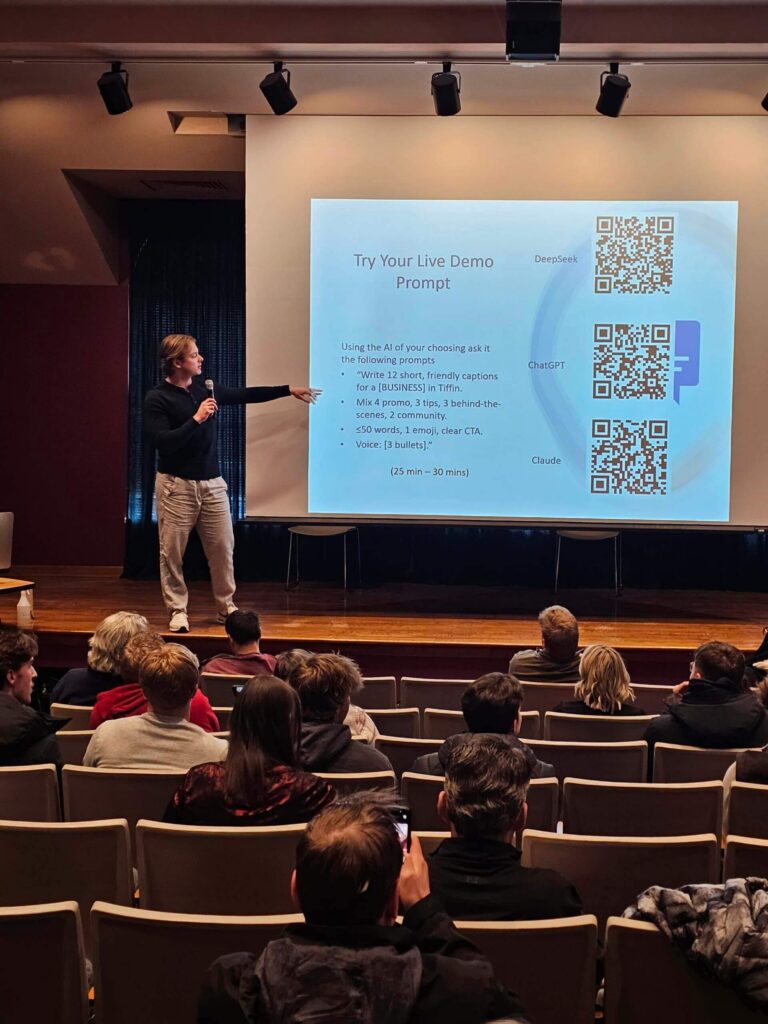
What AI tools, strategies, or business applications stood out most during the session — and why?
AI tools for content creation, customer communication, and workflow automation stood out most. Business owners were especially interested in practical uses of generative AI for social media marketing, email campaigns, customer follow-ups, and idea generation because these tools offer immediate value with minimal cost and learning curve.
How did students prepare to guide business owners through real-world AI applications?
Students prepared through structured coursework, guided workshops, and faculty mentorship. They practiced translating technical AI concepts into simple, business-friendly language and developed demos and examples tailored to small business use cases. This preparation emphasized communication, adaptability, and ethical AI use.
In what ways did local business owners engage with the students during the session?
Business owners actively asked questions, shared their operational challenges, and participated in discussions and demonstrations. Many engaged in one-on-one conversations with students, exploring how AI could be customized to their specific industries and business goals.
How does this initiative support TU’s mission of linking classroom knowledge to professional practice?
This initiative embodies experiential learning by moving beyond theory into applied problem-solving. Students are not just learning about AI, they are using it to support real clients. This directly connects classroom instruction to workforce readiness and professional impact.
What impact do you anticipate this semester-long student–business partnership will have on participating small businesses?
We anticipate that businesses will leave with practical AI strategies they can immediately implement, improved confidence in using technology, and ongoing support from student teams. Over the semester, these partnerships can lead to increased efficiency, stronger digital presence, and more informed decision-making.
How does working directly with community businesses enhance the student learning experience?
Working with real businesses exposes students to authentic constraints, expectations, and communication challenges. It helps them build confidence, professionalism, and problem-solving skills that cannot be fully developed through simulated classroom assignments alone.
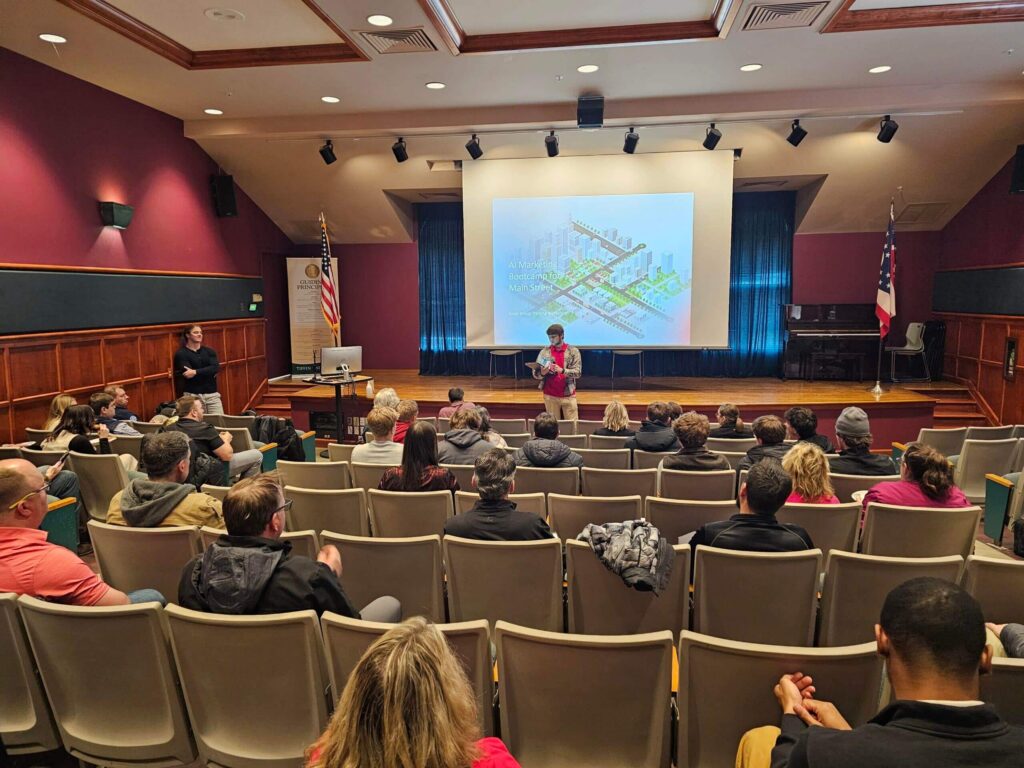
What skills did students develop through leading conversations about AI and business problem-solving?
Students developed technical literacy, communication skills, client consultation experience, teamwork, ethical reasoning, and the ability to adapt AI solutions to diverse business contexts. Leadership and public-facing professionalism were also key outcomes.
Were there any memorable moments, breakthrough conversations, or unexpected takeaways from the event?
One standout takeaway was how quickly business owners recognized that AI is not about replacing people, but about supporting smarter, more efficient work. Several owners expressed relief and excitement once they saw how accessible these tools can be when guided properly.
How does this collaboration position TU as a resource for innovation and workforce development in the region?
This collaboration positions TU as a regional hub for applied innovation, bringing together students, faculty, and businesses to solve real problems. It demonstrates TU’s commitment to preparing students for the future of work while directly contributing to local economic growth.
What are the next steps as student teams begin working more closely with their assigned businesses?
Student teams will conduct needs assessments, identify priority challenges, and co-develop AI-enabled solutions with their assigned businesses. Over the semester, they will provide ongoing support, testing, and refinement, culminating in practical outcomes businesses can continue using beyond the course.