
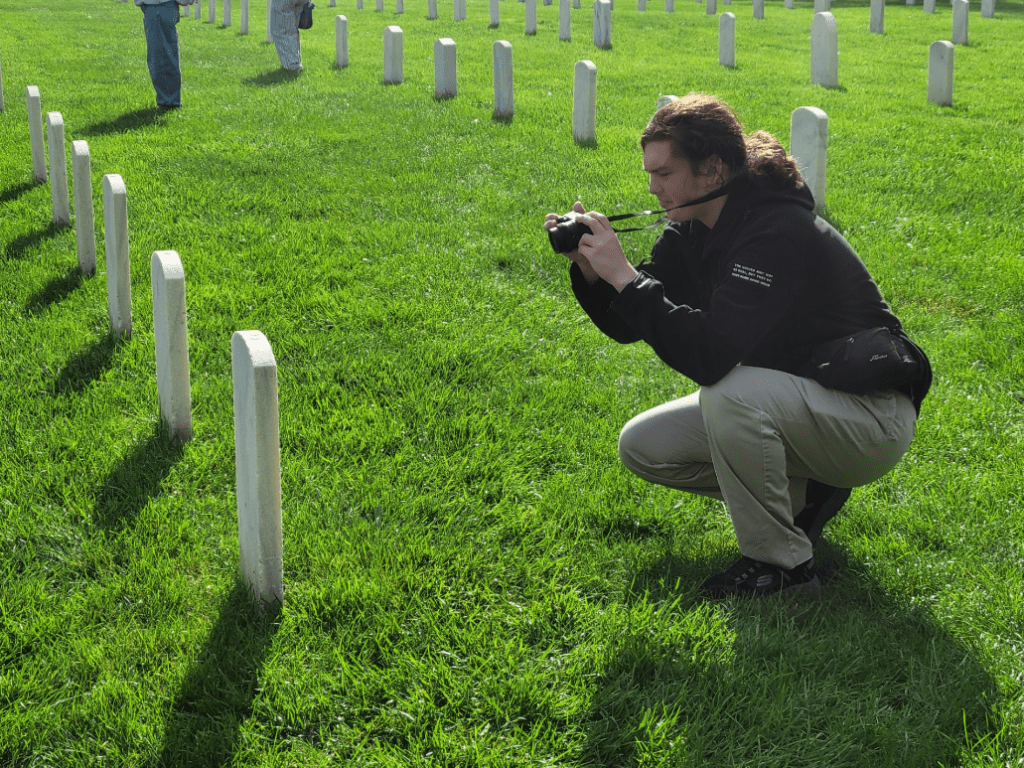
On September 18th and 25th, Tiffin University’s Hidden Digital Narratives Fellows had the opportunity to travel to the Rutherford B. Hayes Presidential Library and Archives and Johnson’s Island to research and investigate the Civil War prison and potentially haunted cemetery located on the island. Johnson’s Island is the chosen topic for this year’s documentary project.
Fellowships at TU provide students with a variety of real-world learning opportunities as an honors-level extensions of their education. Currently, with eight fellowships covering a variety of exciting topics, the Hidden Digital Narratives Fellowship is one of our newest unique experiences available to students. The Hidden Digital Narratives Fellowship gives students the chance to research, film and produce real digital stories through documentary films. Through this program, fellows investigate local and regional stories that touch on the unexplained, from paranormal history and folklore to government projects and other anomalous phenomena.
During these two trips, Hidden Digital Narratives fellows had the opportunity to conduct hands-on research and begin filming content. During their time at the Rutherford B. Hayes Presidential Library and Archives, fellows were able to dive into fascinating documents and artifacts, including a book of original signatures from Civil War prisoners who were kept on the island. Beyond this research, fellows have also done online research to look into the potentially haunted cemetery on the island. During their time visiting Johnson’s Island, fellows had the opportunity to speak with a representative from the Friends and Descendants of Johnson’s island, who provided a tour and historical context of the area. Fellows also took this time to begin filming B-roll and taking photographs that will allow them to take the next step in the production process, writing the script.
Below, Dr. Michael Goodnough and Dr. Stephanni Opfer, Co-Directors of the Hidden Digital Narratives Fellowship, collaborated to answer questions about their recent research trips, the work their fellows are doing and how this Fellowship prepares students for their future careers.
What were the participating students able to accomplish during this trip?
Participating students accomplished a lot during this trip. First, they gained valuable contextual background on the history of the island that will assist in the framing of their script for the documentary. They also took numerous photos/videos for B-roll footage, so they accomplished some filming well ahead of schedule. They also accomplished some team building by all being on the site together and getting a better sense for each other.
Why did you choose Johnson’s Island as the topic of your current project?
We chose Johnson’s Island ultimately because of its proximity to Tiffin and the ease of travel to the location. But the island also offers a fascinating look at Civil War history that includes some paranormal sightings in the cemetery. For our first year of the Fellowship, we wanted a site that has a lot of history behind it in order to provide students with a lot of options for structuring the narrative that did not just include the paranormal. In digital storytelling, context is important, and the history of the island provides that context.
What was the most exciting or interesting finding that your students discovered during this trip?
We were able to hold real artifacts from the Civil War prison, including Civil War bullets, a bayonet and other pieces from the period. Additionally, we were able to see some pottery fragments from the Archaic Period of Indigenous history which were around 10,000 years old. Also, having an archeologist give us a tour of the prison site was very cool and exciting.
What does the process look like for fellows from the introduction of a topic to the completion of the final product?
We have a structured and scaffolded system that follows the industry standard of pre-production, production and post-production stages. In our pre-production stage, we introduce the topic to students and have them research as much as they can before they start writing the script. After we have a rough draft of a script, we start storyboarding so that we know what our camera angles should be as we film each scene. We then take that script and storyboard and create a shot list, which is essentially a list of footage that we still need to capture (or A-roll). Then we move on to the production stage where we do most of the purposeful filming, following our script, storyboard and shot list. Once we have all footage finished, we move on to post-production where all of the A- and B-roll, audio and credits, etc. are edited together into a cohesive film. For this project, we will have our public premiere on April 16th at 1:00PM in Osceola!
How does this project tie into the overall goals of the Hidden Digital Narratives Fellowship?
This project highlights the overall purpose of the fellowship. First, it enhances the technical skills students need in the job market: experience with equipment (video, photo, etc.), experience editing and more. Second, it enhances the critical thinking skills that students need: research, writing, communication and group work skills. Fusing the two together, the project then ultimately presents a “hidden” digital narrative and gives students the opportunity to enhance their portfolio with a public-facing project.
How can students utilize the skills they gain through this Fellowship toward their future career goals?
Beyond the technical skills of crafting a story and creating/editing a documentary, students also gain interpersonal skills by working with each other and negotiating with stakeholders. They need to be professional in their interactions with each other and the public, so this Fellowship starts them thinking of themselves as not just students, but professionals in the field. That shift in mindset matters a great deal.
What did you observe regarding the students’ engagement and growth from this experience?
Although we are still in the early stages of our first project, students are engaged and enhancing their skills. They are excited about what the project can be, and they are serious about putting forth their best effort and giving the public an interesting story.
What would you say to a student considering the Hidden Digital Narratives Fellowship who may be on the fence about joining?
The Fellowship is an opportunity to build the real-world skills you will need for your career, but you will also get to go on adventures and have some fun while adding to your professional portfolio.
What other hands-on learning opportunities will your fellows be participating in for this project?
We will continue to travel as needed and gather more research footage. However, the whole process is hands-on learning. Students will write the script themselves, get the footage, and then edit it all together. The co-directors simply guide students through the process and keep them on track.
What was your favorite part of this research trip? Are there any notable lessons or highlights from the experience that will stick with you?
Dr. Goodnough: My favorite part was getting the chance to visit the archeological site and interact with ancient artifacts.
Dr. Opfer: I love being by the lake, so just going to the island was fun for me. But I was also interested in the archaeology of the site. I’d always known the island had been a Confederate prison, but seeing the places and the artifacts made it more “real.”