
Associate Professor of Biology
Where did you obtain your degrees?
- B.S. in Biology from Bowling Green State University
- Ph.D. in Environmental and Evolutionary Biology from the University of Louisiana at Lafayette
What did you get your degree in, and what inspired that choice?
Growing up my family regularly made trips to the beach and I had a desire to learn about these areas from a young age. During my time as an undergraduate I had a chance to do an internship at the University of Southern Mississippi where I became fascinated with a group of burrow dwelling fish. This led me to pursue a doctorate researching these fish at ULL.
I have recently had a paper from my doctoral research looking at the structure of gills from two populations of wormfish accepted for publication and I am in the process of applying to present this work at an international conference later this year.
My current research consists of two projects. I am collaborating with researchers from Queens University and Georgia College and State University to describe a new species of amphipod. This involves imaging and describing the morphological and genetic features of these small crustaceans.
I am also monitoring the ongoing restoration of a wetland at Van Buren State Park in Findlay Ohio. This project involves identifying various plant species to assess species abundance and distribution within a former reservoir bed to better understand how we can plan restoration efforts in the future.
Tell us about your first job after you graduated from college.
I finished my Ph.D. during the covid lockdown and in the semester prior to graduating I had spent a lot of time transitioning various courses into online and hybrid modalities. When I graduated I was offered a temporary position at ULL to continue teaching those courses and navigate the changing hurdles associated with bringing students back to campus.
How did your career path lead you to teaching at Tiffin University?
I grew up in Columbus and had spent a fair bit of time in Northwest Ohio so when I saw that my position in Louisiana was coming to an end I saw an opportunity to move back to Ohio and closer to family.
How do you prepare students for challenges they’ll face in their careers/after graduation?
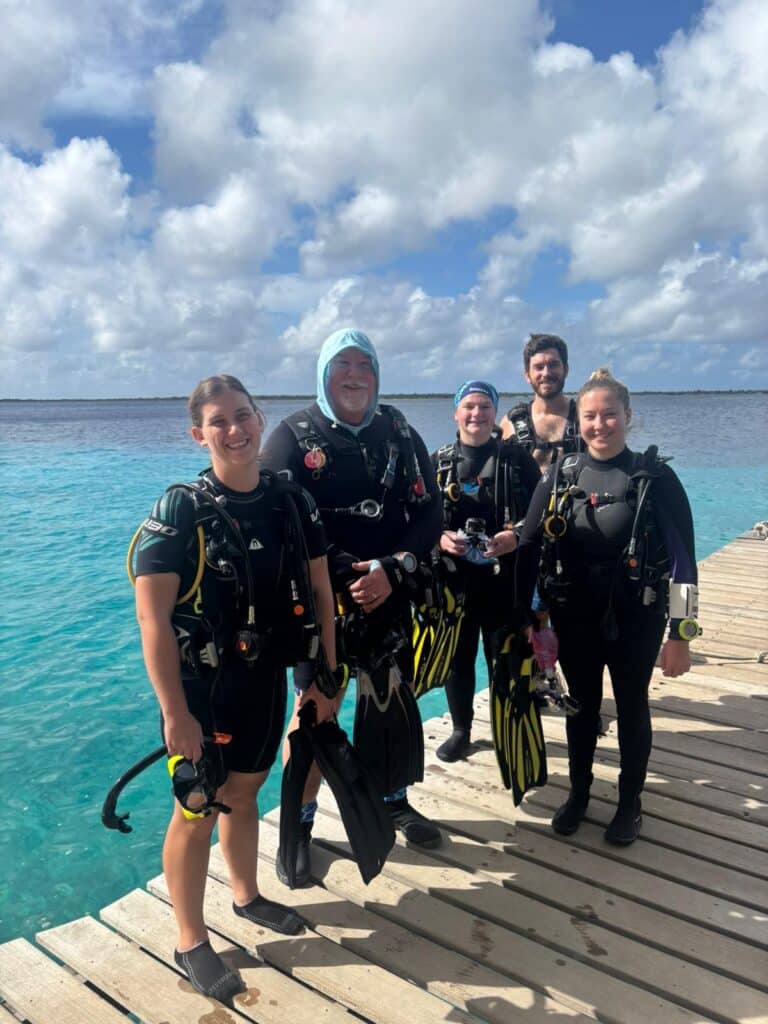
In addition to my own research, I also work to mentor students in learning how to conduct their own research. This includes working through challenges of developing a research question as well as conducting the actual research project. I also help run a course that sees students become SCUBA certified to advance a career in marine science or just have some fun.
What makes Tiffin University stand out to you as a faculty member?
The biggest thing that stands out about TU compared to the other schools I’ve been at is the small class sizes. At other schools I would teach classes of over 300 students making it near impossible to get to know any students. At TU I am able to get to know my student’s goals and interests and better suit my class material to them.
How do you incorporate TU’s motto – “Without risk, there is no gain” – into your own life or classroom?
When conducting research I often take risks by studying animals that lesser known. These animals are often challenging to find in the wild let alone study. I’ve spent months searching for a single species of fish but ultimately this work is satisfying when the work pays off and I am able to better document the behaviors and morphology of these rare species.
I try to incorporate this attitude in helping students develop their own research projects, by taking risks in their research they are able to make new discoveries and learn about the process of conducting research.
What’s a fun fact most people don’t know about you – or an interesting hobby?
I have done several triathlons including a half-Ironman.
What’s your favorite book, film, or quote – and why does it resonate with you?
A quote that has guided a lot of my work is one from Nobel prize winner August Krogh who said “for such a large number of problems there will be some animal of choice, or a few such animals, on which it can be most conveniently studied…we must apply to the zoologists to find them and lay our hands on them.”
This idea has helped me in developing research questions. I often reflect on what biological questions a particular species is well-suited to answer when trying to find a starting point for new research.