
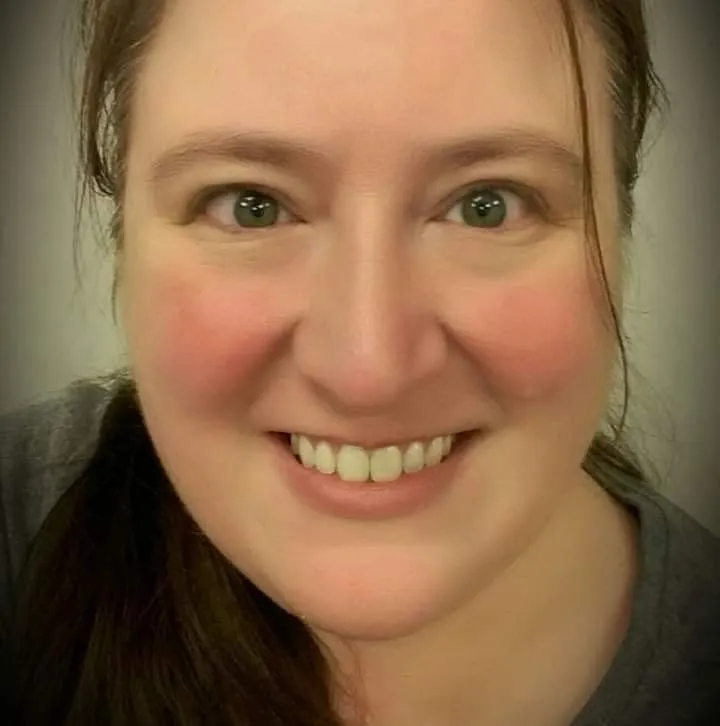
Associate Professor of English
Where did you obtain your degrees?
- Bachelor of Arts in Criminal Justice and Political Science, Ohio Northern University
- Teacher Certification in Integrated Language Arts, Bowling Green State University
- Master of Arts in English, University of Toledo
- Ph.D. in Medieval Literature, Northern Illinois University
What did you get your degree in, and what inspired that choice?
I started out wanting to go to law school, actually. I’ve always been good at logical thinking and writing convincing arguments, but after doing Mock Trial my senior year at ONU, I decided I didn’t like being in a courtroom. But I graduated with my degree anyway and worked in the business industry for a few years.
During that time, I started doing community theater. I’ve always been involved in music and theater, and I met some teachers in several of the shows I was in. I started talking to them about teaching, and I realized that I was made to be a teacher! English was the logical choice because I had always loved the research and writing part of my undergraduate degree, and as an English teacher, I could also teach high school drama.
So I got my teaching certificate from BGSU, taught junior high English and directed the high school plays and musicals for a few years before realizing that public school was not for me. I loved teaching, but I wanted to teach college. So I went back and got my Master’s and PhD.
Medieval literature was the obvious choice for me, really. I’ve always loved reading in the fantasy genre, and medieval literature is fantasy-adjacent, but the larger attraction was the language. I love learning languages, and I am a huge grammar nerd, so learning Old and Middle English was fascinating. Old English is much closer to German than it is to modern English, so I loved puzzling out the texts and then analyzing the historical significance as well as tracing the evolution of English language through the ages. So I devoted my studies to Viking invasions and early English literature!
We do what is best for students. And the small university community lets us get to know our students in ways that just aren’t possible at larger schools… I feel like we can make a difference in our students’ lives and send individuals out into the world who will change things for the better.
Tell us about your first job after you graduated from college.
When I graduated from ONU, I worked in KeyBank’s accounts payable department in downtown Toledo. It was a pretty easy job, but I wasn’t happy there. It wasn’t challenging enough for my brain.
After I got my teaching certificate, my first teaching job was teaching 7th grade English/Reading and being the Drama Director at the high school. I greatly admire and applaud all K-12 teachers, but after a couple of years, I realized that my particular teaching strengths were better suited for older students.
How did your career path lead you to teaching at Tiffin University?
Any career path started out heading in the wrong direction and then took a few detours, but I am now where I have always been meant to be.
Being from the area, I had driven past TU many times, and when I knew I wanted to teach at the college level, I’d always whispered, “please hire me!” as I drove past. When I was on the job market during the last year of my PhD program, I desperately wanted to come back to Northwest Ohio. However, there were only 11 university jobs for medievalists across the entire country, so I applied for them. But I also expanded my search to general English positions, and it just so happened that TU had an open position for an English professor! I went through the hiring process, the universe aligned, and I was hired. What better school for a medievalist than one whose mascot is a dragon?!
How do you prepare students for challenges they’ll face in their careers/after graduation?
I use my own experience of refining my goals to show them that it’s ok if they don’t know exactly what they want to do when they graduate. But the important thing is to keep setting and refining their goals!
In the classroom, I also try to challenge students to think outside the box and give them skills that will set them apart from other applicants in their fields. For example, I’ve recently developed an Interdisciplinary Narrative Communications minor that teaches students how to use narrative techniques in their chosen fields. Narrative skills have become a huge requirement for employers, especially in the field of business. Humans make sense of our world through stories, and people who can communicate using narrative techniques can connect with their audiences far more than those who can’t. By helping students realize this and giving them the tools they need to build on their own ideas, I try to give them every advantage I can so that they can reach their goals and succeed.
What makes Tiffin University stand out to you as a faculty member?
Tiffin University is so flexible in its curriculum and allows faculty to suggest and implement new programs and ideas, more so than any other college or university I have ever been at. That flexibility allows faculty to give students the best opportunities for them to grow not just in their careers but as people, too. We do what is best for students. And the small university community lets us get to know our students in ways that just aren’t possible at larger schools. That alone is worth teaching here. I feel like we can make a difference in our students’ lives and send individuals out into the world who will change things for the better.
How do you incorporate TU’s motto – “Without risk, there is no gain” – into your own life or classroom?
If you don’t do something, you’ll never know if you like it or are good at it! I firmly believe that education should be relevant to students’ lives and even a little fun, so I’m always looking for new activities and assignments to try in my classroom. If they don’t work, I’ll try something else. But I encourage the same kind of thinking in my students. I tell them to give things their best shot, and if they fail, this is college. They can try again. The real world is less forgiving, so if they use every opportunity they have while they’re here, they will get to know themselves and may find new interests or talents.
What’s a fun fact most people don’t know about you – or an interesting hobby?
Many years ago, through my community theater connections, I worked as a gypsy fortune teller at Cedar Point Halloweekends. I got really good at reading people’s expressions and body language at that job! Now, instead of being on stage, I play the flute (and a little clarinet) in pit orchestras. Most recently, I’m playing the Irish whistle part in three different productions of Come From Away.
What’s your favorite book, film, or quote – and why does it resonate with you?
My email signature is a quote from Tolkien’s The Fellowship of the Rings.
“I wish it need not have happened in my time,” said Frodo.
“So do I,” said Gandalf, “and so do all who live to see such times. But that is not for them to decide. All we have to decide is what to do with the time that is given us.”
Sometimes we don’t have control over what happens to us, and that can be so hard for us to deal with. But if we focus on what we can’t control, we’ll only drive ourselves nuts. So I try to concentrate on the things I CAN control. There’s an Old Norse proverb in the Havamal of the Poetic Edda that says, “Ósviðr maðr vakir um allar nætr ok hyggr at hvívetna þá er móðr er at morni kømr alt er vil sem var.” Loosely translated, it means, “The unwise man is awake all night worrying; when morning comes, he’s tired and the problems still exist.” It’s the same sort of idea. Or of course, there’s always, “Not my circus; not my monkeys.”