

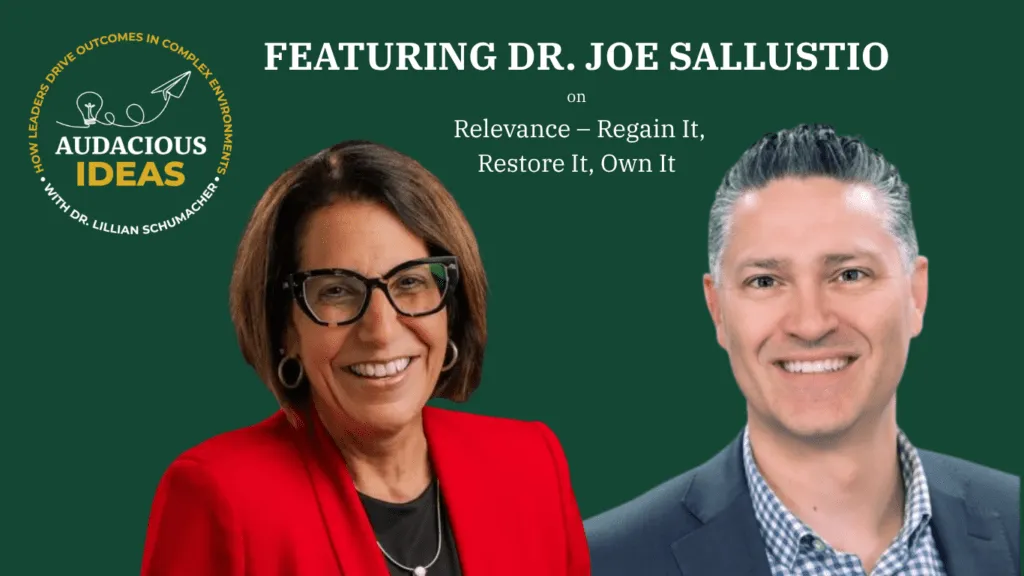
In the first episode of Audacious Ideas, my conversation with Dr. Joe Sallustio kept returning to the word relevance.
Joe has interviewed more than 475 college and university presidents through The EdUp Experience, giving him a unique perspective on how higher education leaders are responding to change. His challenge to our sector was direct, “Regain it, restore it, own it.”
I have continued thinking about those words.
Relevance cannot be assumed because an institution has existed for decades or because higher education has historically played an important role in society. It is demonstrated through the value we create for students, employers, and communities.
Increasingly, that requires us to listen beyond our own campuses.
Listening to What the Workforce Needs
One of the most interesting parts of our conversation centered on artificial intelligence and the distinction Joe made between AI literacy and AI competency.
Understanding AI is one thing, but employers increasingly need people who can use these tools effectively, apply judgment to their outputs and understand where technology can create meaningful value.
That distinction has important implications for higher education.
Technology will continue to evolve, and no university can predict every tool graduates will encounter throughout their careers.
Our responsibility is to prepare students to learn, adapt, and apply emerging technologies thoughtfully.
That thinking is central to our AI Forward strategy at Tiffin University. We are looking closely at where the world of work is going and what our students will need to be prepared for it.
Relevance requires that connection between education and the world students are preparing to enter.
The More Technology Advances, the More Relationships Matter
Our conversation also reinforced something I believe deeply about leadership. As technology becomes more capable, human connection becomes more valuable.
Joe described relationships as a form of currency in an increasingly AI-enabled world.
Technology can help us analyze information, improve processes, and expand what individuals and organizations can accomplish. But trust, judgment, empathy, communication, and the ability to understand another person’s perspective remain distinctly human strengths.
Those qualities matter in the workplace, they matter in leadership, and they matter tremendously in education.
Preparing students for an AI-enabled future therefore requires attention to both helping them develop technological competency while continuing to strengthen the human capabilities that allow them to lead, collaborate, and contribute.
Relevance Requires Curiosity
Joe and I covered much more in our conversation, from the changing role of the college president to institutional readiness for technology and the temptation to search for a single solution to complex challenges.
The idea of relevance connects them all.
Remaining relevant requires curiosity about what is changing, humility about what we do not know, and a willingness to listen to people beyond our own organizations and industries.
That is also one of the reasons we created Audacious Ideas: How Leaders Drive Outcomes in Complex Environments.
The challenges facing higher education are not ours alone. Employers are navigating AI and workforce transformation. Businesses are reconsidering how they develop talent. Leaders across sectors are adapting to disruption, changing expectations, and uncertainty.
There is tremendous value in bringing those perspectives together.
My conversation with Joe was a fitting place to begin.Listen to Dr. Joe Sallustio: Relevance – Regain It, Restore It, Own It, the first episode of Audacious Ideas: How Leaders Drive Outcomes in Complex Environments.