
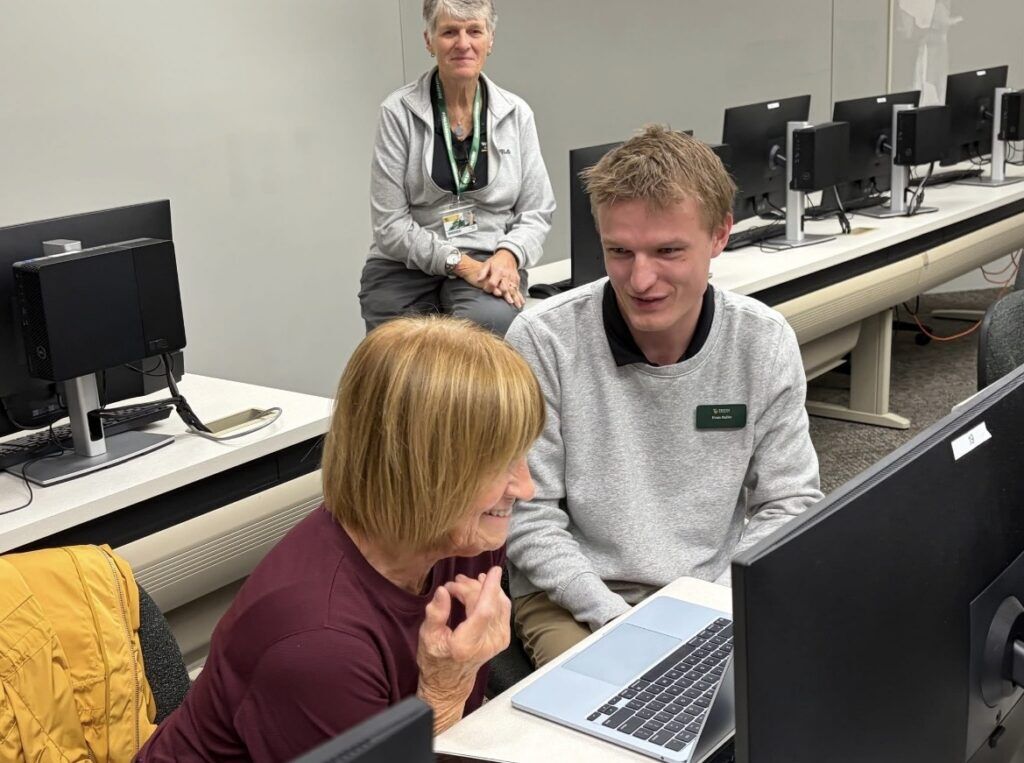
On Friday, October 16th, Tiffin University’s White-Collar Crime Fellowship partnered with the Ethical Hacking Fellowship to provide a hands-on fraud prevention and digital safety workshop for LIFE@TU members.
During the two-hour session, students worked directly with community members to help them better protect themselves from fraud and cyber-related threats. The workshop focused on practical assistance, including recognizing suspicious emails and text messages, reviewing device security settings, identifying common scams, protecting personal information and discussing steps individuals can take to reduce their risk of becoming victims of fraud.
The event provided a unique opportunity for students to apply what they are learning while providing a meaningful service to members of the community.
Below, Dr. Rhonda Gilreath, Director of the White-Collar Crime Fellowship, answers questions about the workshop, including what was accomplished, how it relates to the goals of the fellowship and how this fellowship prepares students for their future careers.
What was the overall purpose of the workshop and what was accomplished during it?
The overall purpose of the workshop was to provide LIFE@TU members with practical, individualized assistance related to fraud prevention and digital security. Rather than simply presenting information about fraud and cybersecurity, we wanted participants to have an opportunity to work directly with students and address questions or concerns they may have about their own devices, suspicious communications, scams and personal information.
During the workshop, participants received assistance with areas such as identifying suspicious emails and text messages, recognizing common fraud schemes and learning steps they can take to better protect their personal and financial information. The goal was for participants to leave with practical knowledge and actions they could immediately use.

What role did the White-Collar Crime Fellowship students play in this workshop?
The White-Collar Crime Fellowship students played an active role in working directly with LIFE@TU members. They applied what they have been learning about fraud schemes, behavioral and financial red flags, fraud prevention and the importance of asking questions before reaching conclusions.
One of the goals of the Fellowship is for students to learn by doing, so opportunities like this allow them to move beyond discussing fraud in a classroom setting. They must learn how to communicate fraud prevention information clearly, listen to an individual’s concerns, recognize potential warning signs and help someone determine appropriate next steps while maintaining professionalism and respecting privacy.
What was the significance of collaborating with both the Ethical Hacking Fellowship and LIFE@TU for this workshop?
The collaboration was particularly valuable because fraud and cybersecurity are increasingly interconnected. Many of today’s fraud schemes begin through technology, whether through phishing emails, fraudulent text messages, compromised accounts, social engineering or other forms of cyber-enabled fraud.
The Ethical Hacking Fellowship brought expertise related to cybersecurity and device protection, while the White-Collar Crime Fellowship contributed the fraud-prevention and fraud-detection perspective. LIFE@TU gave our students an opportunity to apply those skills while serving members of the community.
It also demonstrates the value of interdisciplinary learning. In the real world, financial crime investigations frequently require professionals from different disciplines to work together. This collaboration gave students experience doing exactly that.
Are you planning to host similar workshops in the future?
Yes, community engagement is an important component of the White-Collar Crime Fellowship, and I would like to continue developing opportunities where our fellows can use their knowledge to help others recognize and prevent fraud. We would like to offer this workshop annually.
Fraud schemes are constantly changing, so there will always be a need for fraud awareness and prevention education. As the Fellowship continues to grow, I would like our students to become increasingly involved in developing and delivering fraud-prevention programs for LIFE@TU members and other community audiences.
How does this workshop tie into the overall goals of the White-Collar Crime Fellowship?

The workshop directly supports the mission of the White-Collar Crime Fellowship, which is to prepare the next generation of fraud and financial crime professionals through experiential learning, interdisciplinary collaboration and community engagement while helping protect individuals, businesses and communities from fraud.
Students can learn about fraud from textbooks and case studies, but there is tremendous value in giving them the opportunities to apply that knowledge. Through experiences such as this workshop, fellows develop technical knowledge as well as communication, professionalism, ethical decision-making, teamwork and problem-solving skills.
The workshop also reinforces an important part of fraud examination that can sometimes be overlooked: preventing someone from becoming a victim is just as important as investigating what happened after a fraud occurs.
What other hands-on learning opportunities will your fellows by participating in?
The Fellowship is designed around experiential learning. Fellows participate in professional guest-speaker sessions, organizational visits, fraud case analysis, financial-document and transaction analysis, fraud-risk assessments, community fraud-prevention initiatives and practical exercises that require them to recognize red flags and determine what evidence would be needed before reaching a conclusion.
As students progress through the Fellowship, the experiences will become increasingly advanced. We plan to incorporate mock investigations, investigative interviewing, financial transaction analysis, evidence evaluation and opportunities to examine different types of financial crime.
We also want students to learn directly from professionals working in the field. For example, this fall our Fellows had the opportunity to meet with Justin Gates from the Ohio Attorney General’s Office and learn about Medicaid fraud investigations, current fraud schemes and careers related to financial crime. Experiences such as these allow students to connect what they are learning with how fraud is actually prevented, detected and investigated.
What sort of community or regional partnerships are in place for the White-Collar Crime Fellowship? Are there any partnerships that you are hoping to establish in the future?
Building strong professional and community partnerships is a major priority for the Fellowship. We have already begun developing relationships that allow students to interact with professionals involved in fraud investigation, law enforcement, cybersecurity, business and fraud prevention. Our work with LIFE@TU and the Ethical Hacking Fellowship is one example, and the Ohio Attorney General’s Office has also provided our students with valuable professional exposure.
As the Fellowship develops, I hope to continue expanding partnerships with law enforcement agencies, financial institutions, businesses, forensic accounting professionals, prosecutors, regulatory agencies and professional organizations such as the Association of Certified Fraud Examiners. These relationships can provide guest speakers, organizational visits, mentorship, internships, professional networking and eventually opportunities for students to contribute appropriately to real-world fraud prevention and investigative efforts.
How can students utilize the skills they gain through this Fellowship toward their future career goals?

The skills developed through the Fellowship are applicable to a wide variety of careers. Fraud and financial crime are not limited to one profession. These skills are valuable in accounting, forensic accounting, law enforcement, cybersecurity, banking, compliance, corporate investigations, internal audit, risk management, insurance, government and many other fields.
Students learn how to recognize red flags, analyze information, examine transactions and documentation, ask effective questions, evaluate evidence, communicate findings, work as part of an interdisciplinary team and approach situations ethically and objectively.
Just as importantly, fellows will graduate with experiences they can discuss with employers. Instead of only being able to say they studied fraud, they can discuss how they applied what they learned through case analysis, community outreach, professional interactions, organizational consultations and investigative exercises.
What would you say to a student considering the White-Collar Crime Fellowship who may be on the fence about joining?
I would tell them that if they are interested in understanding how fraud happens, how financial crimes are investigated, how technology is changing crime or how they can use their career to help protect individuals and organizations, they should consider applying.
Students do not need to be accounting or criminal justice majors. One of the strengths of the Fellowship is that students from different academic backgrounds bring different perspectives to an investigation. An accounting student may notice something in a financial transaction, a criminal justice student may approach the behavior or investigative process differently and a cybersecurity student may recognize important electronic evidence.
The Fellowship gives students an opportunity to gain experiences they may not otherwise have during their undergraduate education, meet professionals working in the field, develop their professional network and discover career possibilities they may not have previously considered.
What are you looking forward to most as the White-Collar Crime Fellowship continues to grow?
I am most excited about watching the students grow along with the Fellowship. This is the inaugural group of fellows, so they are helping establish what this program will become. As they gain experience, I want them to take increasing ownership of the Fellowship by leading projects, mentoring future fellows, conducting more advanced analyses, participating in community initiatives and eventually working on increasingly realistic investigative experiences.
I am also excited about expanding our relationships with community organizations and professionals. The long-term vision is to create a program where students from multiple disciplines work together, learn directly from experienced professionals, provide meaningful service to the community and graduate with practical experience that distinguishes them when they enter their careers.
Ultimately, I look forward to seeing where these students go professionally and knowing that the experiences they gained through the White-Collar Crime Fellowship helped prepare them to become ethical professionals who can make a difference in preventing and investigating fraud.