
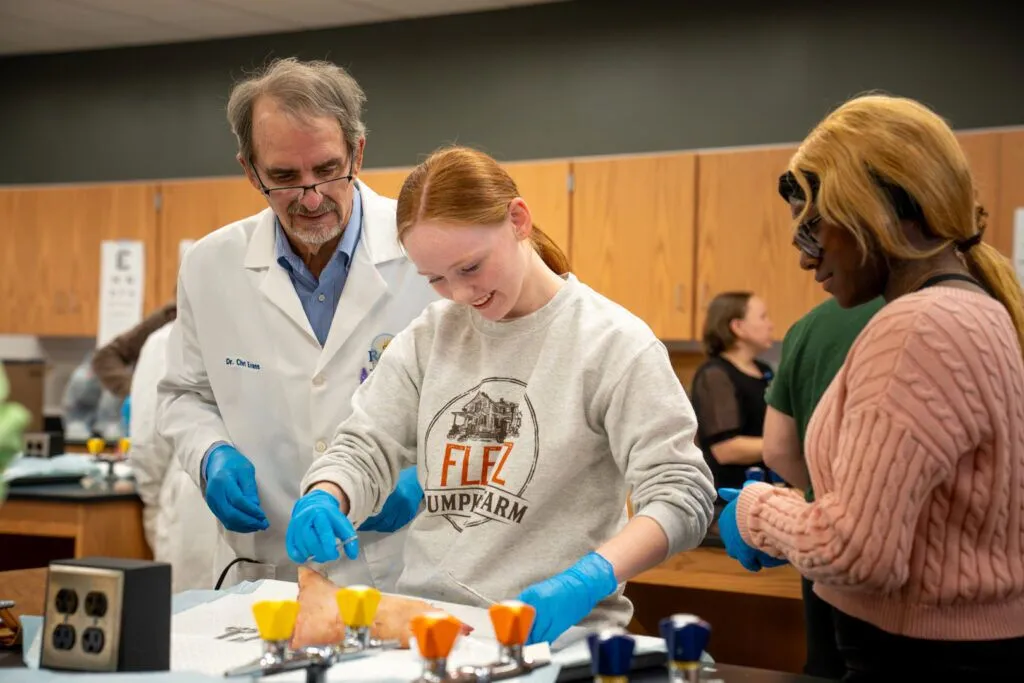
On Thursday, November 12th, students interested in pursuing a career in the STEM and healthcare world were invited to participate in a suturing workshop designed to get their feet wet and build confidence in their pursuit of a career in healthcare. The pig feet suturing workshop was a unique opportunity for students to gain hands-on learning experience to get them accustomed to the work they would do in a graduate-level pre-med program and beyond within a healthcare career.
Participating students had the chance to work with and learn from faculty members of the Applied Health Science and Nursing programs, along with special guest Dr. Chet Evans, a Tiffin University Board of Trustees member and surgeon. Dr. Evans is an executive administrator, world-recognized medical educator, wound and accreditation specialist, nationally recognized GME expert, surgeon and entrepreneur. Dr. Evans was present to help walk the students through the suturing process and answer their questions throughout the workshop.
Below, Dr. Jamie Tooman, Assistant Dean of Nursing, and Dr. McKenzie Posey, Nursing Program Coordinator, and Dr. Evans didn’t hog any information when answering questions about the workshop. This includes a reflection on what the students were able to do, why they chose to host this workshop and more information on hands-on learning opportunities offered here at TU.
What were students able to accomplish during this workshop?

Jamie: Students had the unique opportunity to step outside of the traditional classroom and experience a little bit of what it feels like to be a healthcare professional! Dr. Chet Evans, a Tiffin University Board of Trustees member and accomplished surgeon, introduced students to distinct types of wounds, wound management and basic suturing techniques. After his presentation and demonstration, students rolled up their sleeves and put their new knowledge to work! Using pig feet and actual suturing kits, students practiced making incisions and closing them with sutures. For many, this was their first experience performing a hands-on clinical skill, and it was exciting to watch them gain confidence with each stitch.
McKenzie: Beyond learning the mechanics of suturing, they were able to apply critical thinking, fine motor skills and problem-solving in a realistic setting. The workshop gave students an opportunity to move from observing healthcare procedures to actively participating in them, helping them better understand the precision, patience and attention to detail required in patient care.
Why pig’s feet?
Jamie: Believe it or not, pigs’ feet are a fantastic teaching tool! Pig skin has similarities to human skin in its structure and texture, making it a useful model for practicing basic suturing techniques. It allows students to experience the resistance of tissue and understand how to properly handle a needle and suture material. Plus, there is something memorable about telling your friends you spent your evening stitching up a pig’s foot! It is a fun, safe and educational way to introduce students to clinical skills without working on actual patients.
McKenzie: Pigs’ feet provide an excellent bridge between classroom learning and real-world healthcare experiences. They offer students a safe, accessible way to practice techniques on tissue that behaves similarly to human skin. This allows students to develop confidence handling instruments and suturing materials while gaining an appreciation for the technical aspects of wound closer before ever entering a clinical setting.
What was the goal of the workshop?
Jamie: Our goal was simple: spark curiosity, inspire future healthcare professionals and give students an opportunity to experience healthcare beyond a textbook. We wanted students to explore a skill they may not otherwise encounter until much later in their education. Just as importantly, we wanted to connect students with an accomplished healthcare professional who could share his knowledge, experiences and passion for the field. At Tiffin University, we believe learning should be engaging, meaningful and sometimes a little outside your comfort zone!
McKenzie: The goal was to create an immersive STEM learning experience that allowed students to explore healthcare through direct participation. We wanted students to engage with a hands-on activity, interact with an experienced surgeon and gain insight into a clinical skill they may encounter in future healthcare careers. Events like this help students connect the science they learn in the classroom with its practical applications.
How do you think the students enjoyed the experience?
Jamie: The students really enjoyed having the opportunity to do something different! There is a certain excitement that comes with putting on gloves, picking up surgical instruments and realizing, “hey, I can actually do this!” Watching students concentrate on their first stitch and then begin to feel more comfortable with the technique was wonderful. These are the kinds of experiences students remember long after the workshop ends. It was not about learning to suture but about having fun while discovering what they can accomplish.
McKenzie: The enthusiasm in the room was evident from the moment students began practicing. Many students were eager to challenge themselves with something completely new, and the hands-on nature of the workshop kept them engaged throughout the evening. Students asked thoughtful questions, compared techniques with one another and celebrated their successes as they improved. It was exciting to see their curiosity turn into confidence.
What was the overall value of hosting this workshop?
Jamie: The value goes far beyond learning how to place a few stitches. Workshops like this bridge the gap between classroom education and real-world healthcare. Students gain exposure to clinical techniques, interact with experienced professionals and begin to envision themselves in healthcare careers. It was also a wonderful opportunity to bring students from different academic disciplines together around a shared interest in healthcare. Having Dr. Evans, who serves on our Board of Trustees, personally invest his time and expertise in our students demonstrates the commitment of the Tiffin University community to student success. These connections and experiences are what make a university education special.
McKenzie: The workshop provided students with an experience that cannot be replicated through lectures alone. It brought together science, healthcare and practical skill development in a meaningful way. Students were able to learn from an accomplished surgeon, collaborate with peers who share similar interests and explore potential career paths. These experiences help students make informed decisions about future educational and professional opportunities.
What was your favorite part of the workshop?
Jamie: Without a doubt, my favorite part was watching the students’ faces when they successfully completed their first suture! There is something incredibly rewarding about seeing a student go from being a little hesitant to proudly showing off their work. As a nurse and educator, I love those moments when students realize they are capable of doing something they have never tried before. I also enjoyed seeing Dr. Evans interact with our students, sharing not only his clinical knowledge but also his enthusiasm for healthcare. And, of course, watching a room full of college students get excited about stitching up pigs’ feet was entertaining! I also enjoyed hearing their plans; we had future ER doctors, dentists, surgeons and nurses in the room.
McKenzie: My favorite part was watching students surprise themselves. You could see the hesitation at first when they picked up instruments, but after a few attempts, they were completely focused and excited about what they were accomplishing. By the end of the workshop, students were comparing sutures, sharing tips with one another and proudly showing off their work. I love seeing those moments when students realize, “I can do this.” Confidence is built one experience at a time, and this workshop gave students a chance to step outside their comfort zone and discover new skills in a supportive environment. Plus, there is something pretty memorable about spending an evening learning from a surgeon while suturing a pig’s foot alongside your friends!
Dr. Chet Evans: I am glad the students enjoyed the workshop! I think these types of events may sometimes be the spark or at least a reinforcement for students entering or considering the health professions. The satisfaction and accomplished look on their faces after learning a simple technique is my great reward!
Why would a student want to participate in a workshop like this?
Jamie: Why wouldn’t they? How often do you get the opportunity to learn clinical skills directly from an experienced surgeon while you are still exploring your career options? Whether a student is interested in nursing, medicine, physician assistant studies or another healthcare profession, experiences like this provide an opportunity to explore the field in a fun, low-pressure environment. Students can ask questions, try something new and discover interests they may not have realized they had. You do not need to know exactly where your healthcare journey will take you to benefit from an experience like this. Sometimes, one workshop can open the door to an entirely new career interest.
McKenzie: Because learning should be hands-on, memorable and fun! Opportunities like this allow students to experience healthcare in a way that goes far beyond reading a textbook or watching a video. Where else can you learn directly from a surgeon, practice a real clinical skill and gain insight into a healthcare career all in the same evening? Even if a student is still deciding between nursing, medicine, dentistry or another STEM field, workshops like this provide a chance to explore those interests firsthand. As a faculty member, I always encourage students to say “yes” to experiences like these. You never know what might spark a passion, build your confidence or become the moment that helps you realize where your future is headed. Sometimes all it takes is one workshop, one conversation or even one stitch to see a whole new career path open up.
How can students utilize the skills and knowledge they gained during this workshop throughout the rest of their higher education career?
Jamie: While students are not going to leave this workshop ready to perform sutures on patients, they are leaving with something equally important: confidence, curiosity and a better understanding of clinical practice. The workshop introduced students to anatomy, wound healing, tissue healing, infection prevention and the importance of precision and attention to detail. These concepts connect to many of the science and healthcare courses they will encounter throughout their education. It also reinforces critical thinking, hand-eye coordination, patience and the importance of practice. Most importantly, it encourages students to approach new challenges with the mindset that they can learn difficult skills through education, practice and determination.
McKenzie: While most students won’t be suturing patients anytime soon, the lessons learned during this workshop extend far beyond placing stitches. Students had the opportunity to practice patience, focus, problem-solving and attention to detail, all skills that are valuable in healthcare, science and countless other professions. Experiences like this also help students connect what they’re learning in the classroom to real-world applications. Whether they’re studying anatomy, biology, chemistry or nursing concepts, they can now better understand how that knowledge is used in practice. Most importantly, students leave with greater confidence and the realization that learning complex skills becomes much more manageable when they’re willing to jump in, ask questions and practice.
What other workshops or classroom activities do you offer or plan to offer to help your students gain hands-on learning experience?
Jamie: This workshop is just the beginning of the types of engaging healthcare experiences we want to bring to Tiffin University! As we continue to grow our nursing programs and healthcare-related opportunities, I would love to see more interactive workshops focused on areas such as emergency response, CPR and lifesaving techniques, patient assessment, medical simulations, healthcare technology and other clinical skills. We also want to continue inviting healthcare professionals to campus so students can learn directly from individuals working in the field. My vision is to create opportunities where students do not just hear about healthcare careers but get to experience pieces of them. We want Tiffin University to be a place where future healthcare professionals can explore, discover and develop their passion for helping others.
McKenzie: This workshop is exactly the kind of experience we want to continue bringing to our students, and we plan to have many more engaging activities ahead. Healthcare is a hands-on profession, and I believe students learn best when they’re actively engaged in the process. We are fortunate to have incredible community partners and healthcare experts who are willing to share their knowledge with our students. The goals it to give students opportunities to explore different healthcare careers before they commit to a specific path. The more experiences students can have during their undergraduate years, the more informed, prepared and confident they’ll be as they move toward their future careers.
What advice do you have for a student looking to pursue a career in the world of healthcare? How could an undergraduate experience, like this workshop, assist them in reaching their career goals?
Jamie: My biggest advice is to be curious, get involved and never pass up an opportunity to learn something new! Healthcare is an incredibly rewarding field, but it is also one that requires dedication, compassion, adaptability and a willingness to continue learning throughout your career. You don’t have to have your entire career mapped out when you enter college. Some of the best career discoveries happen when you step outside of your comfort zone and try something you never imagined doing. Attend the workshop. Ask the questions. Talke to the professionals. Volunteer. Shadow someone in a healthcare setting. Take advantage of every opportunity your university provides. As someone who began my nursing career in critical care, I can tell you that healthcare offers so many different paths and opportunities for growth. You never know where your journey might lead. At Tiffin University, we want to help students discover those possibilities early. Experiences like this workshop can ignite a passion, build confidence and help students realize that a future in healthcare is within reach. And who knows? That first stitch in a pig’s foot might just be the moment a student discovers their calling in healthcare!
McKenzie: My biggest piece of advice is to become a sponge. Say yes to opportunities, even the ones that feel a little outside your comfort zone. Attend the workshop, introduce yourself to the guest speaker, volunteer, shadow a professional, join a student organization and be willing to try things you’ve never done before. One of the greatest advantages of being a student is having access to experiences designed to help you explore, learn and grow. Take advantage of them. The students who get the most out of their college experience are often the ones who raise their hand, ask questions and actively seek opportunities instead of waiting for them to come along. Healthcare is not a one-size-fits-all profession, and you do not need to have your entire future mapped out today. In fact, many healthcare professionals discover their passion through experiences they never expected to have. A workshop like this gives students the chance to explore a potential career interest, build confidence and see themselves in a professional role before they ever enter the workforce. Personally, I never really knew what I wanted to be when I grew up. My career path certainly wasn’t a straight line. What I did do was say yes to opportunities, stay open to new experiences and learn from the people around me. Each experience lead to another, and eventually that path led me to Tiffin University, which I’m incredibly grateful for. One of my favorite things is watching students create a path that is uniquely their own. I encourage students to stay curious, get involved and not be afraid to blaze their own trail. Soak up every opportunity you can. The skills you gain, the people you meet and the experiences you collect will shape your future in ways you cannot always predict. Sometimes the opportunity that changes your life doesn’t look life-changing at the time. Sometimes it starts with something as simple as saying “yes” to a workshop and making that first stitch. And, of course, Go Gons!